| |
| Tuesday, 24 November 2026 |
| How to Look Slowly: Impressionism |
| Joanne Rhymer |
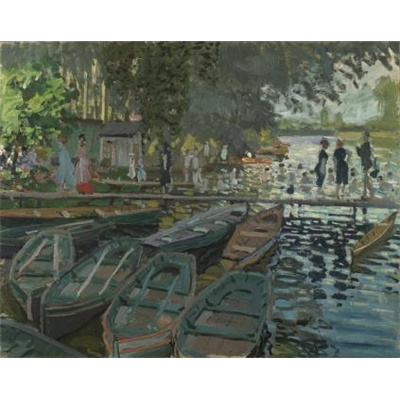 |
Bathers at La Grenouillère - Claude Monet (National Gallery) Looking slowly at an Impressionist painting might at first seem counterintuitive, since one of the concepts associated with Impressionism is that the artist captures quickly in paint a fleeting, fugitive moment. However, although their works frequently appear to have been painted speedily, in reality, this was not always the case. Impressionists’ paintings were often the result of careful observation and planning and they invite us to dwell on and enjoy the evocation of a transitory effect. When we look slowly at an Impressionist painting, touches of paint, punctuations of colour and the varied textures and brushstrokes come alive. Looking at a small selection of works, with particular attention to the innovations of the style, you will develop visual analysis skills and tools for looking. Our lecturer: Jo is an art historian passionate about making art accessible, engaging and relevant to all. After more than 25 years working in museums and galleries across the UK and abroad, she now shares her love of art through teaching, writing and creating public programmes and events. Her areas of expertise include 19th- and early 20th-century French and British art. She is also interested in the skills associated with visual literacy and close looking. |
|
| Tuesday, 15 December 2026 |
| How we Laughed: The Golden Age of British Comedy |
| Tyler Butterworth |
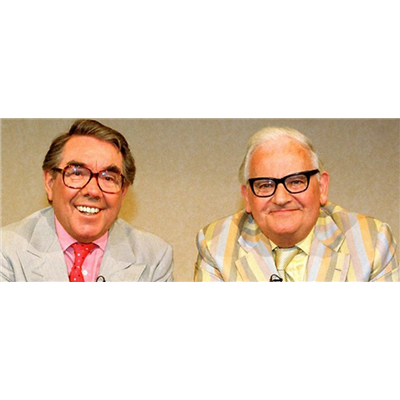 |
It’s said that in our theatrical history there was a Golden Age of British Comedy. It ran from the 1970’s to the 1980’s and occurred as we started to drift away from theatres and radios, and found ourselves living through a wonderfully rich period of television comedy. Some say this period has never been bettered. Our lecturer: Tyler Butterworth grew up in a theatrical family and spent twenty-five years as an actor working extensively in film, television, theatre and radio. He then worked as a development producer in television documentaries. Now, he produces walking audio guides to cities across Europe for private clients. He lives in Sussex where he walks on the South Downs and the South Coast. |
|
| Tuesday, 26 January 2027 |
| Persepolis: Art, Architecture and Ideology of the Persian Empire
|
| James Renshaw |
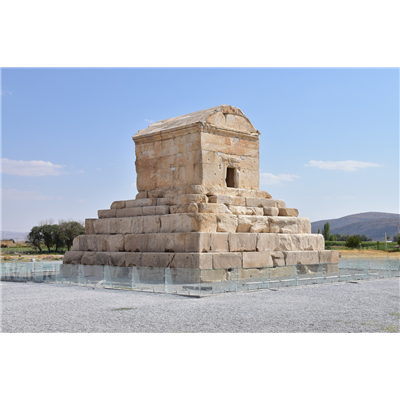 |
The Persian empire exploded into life during the middle of the 6th Century BC and was the largest empire in the world for the next two centuries. In around 515, its third Great King, Darius I, commissioned the building of a new city, Persepolis, with his palace at its centre. We know a great deal about this palace – there is even a replica one of its central features, the Apadana Staircase, in the British Museum. What can this palace and its art tell us about the ideology of this extraordinary empire? Our lecturer: James Renshaw gave us a lecture in 2025 on Pompeii and Herculaneum, and we have now invited him back to talk about Persepolis. He is a keen traveller, and has been lucky enough to have taken many photos of ancient sites, a number of which have been used in his books and lectures. |
|
| Tuesday, 23 February 2027 |
| Wandering Lonely? The True Story of Wordsworth’s Daffodils |
| Annalie Talent |
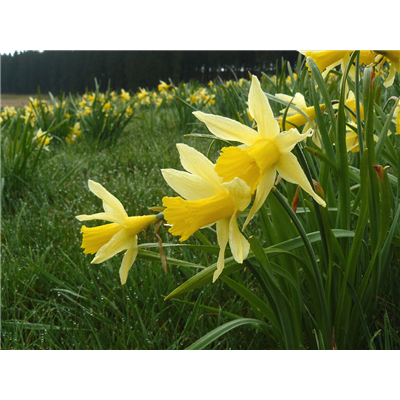 |
I wandered lonely as a cloud/That floats on high o’er vales and hills… Wordsworth’s Daffodils is one of the most famous poems in the English language. Frequently anthologised and oft quoted, it’s the poetic equivalent of Constable’s Hay Wain; it is instantly recognisable, even by people who don’t like poetry. This timely lecture as the first of the daffodils appear takes us back in time to tell the true – and often surprising - story of Wordsworth’s best-known poem. Our lecturer: Annalie spent several years working on education programmes at museums and literary houses across the UK, including the Wordsworth Trust, Grasmere; Wordsworth House in Cockermouth; Jane Austen’s House in Hampshire; and the Ashmolean Museum in Oxford. She uses her knowledge and personal experience of literary houses - and their collections - to offer a unique perspective on writers and their works. |
|
| Tuesday, 30 March 2027 |
| Morocco Blues – Why and How the Country Changed Colour
|
| Elizabeth Gowing |
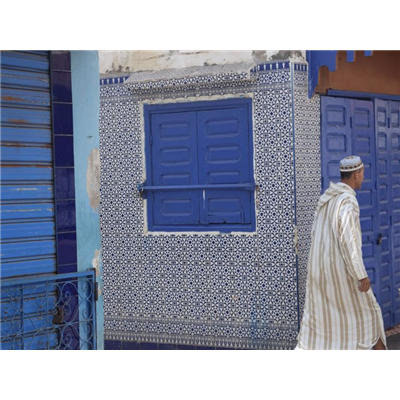 |
This lecture draws on Elizabeth’s time in Morocco in visits spanning more than 25 years. It will focus particularly on the stories behind the blue pigment used for the fishing boats and doorways of photogenic Essaouira on the Moroccan coast, and the Majorelle Blue developed and patented by French artist Jacques Majorelle in Marrakech in the 1920s. The story of Morocco’s blues takes us from Berber veils to Yves Saint-Laurent who restored Majorelle’s Marrakech garden, via Modernist Orientalist art and a protected mollusc... Our lecturer: Elizabeth studied at Magdalen College Oxford before training as a teacher and working in London. She moved to Kosovo in 2006 and there worked with the Ethnological Museum in Prishtina and co-founded ‘The Ideas Partnership’, a charity working on education and cultural heritage projects. Elizabeth is a regular contributor to Radio 4 (Saturday Live, Excess Baggage, From Our Own Correspondent) and the BBC World Service. |
|
| Tuesday, 27 April 2027 |
| The Newlyn School – Art in Cornwall 1880-1930
|
| Alison Bevan |
 |
The legendary quality of light, dramatic landscape and sparking turquoise seas have drawn artists to West Cornwall for over 200 years. This talk explores the 'Newlyn School' artists, from their first flowering to the later Lamorna colony, together with their contemporaries in nearby St Ives. Our lecturer: Alison Bevan is an acknowledged expert on the Newlyn School, and her book 'The Art of the Newlyn School: Paintings of Cornish Life and Light' is being published by Sansom & Company in October 2026 to accompany a touring exhibition she has curated as part of the "Going Places" programme by the Art Fund. |
|
| Tuesday, 25 May 2027 |
| Edwin Lear – Bird, Animal and Landscape Paintings
|
| Felicity Herring |
 |
Edward Lear was born in 1812, he was the 20th child of Jeremiah, a London stockbroker and his wife Ann. With so many children to care for his mother handed him over to his elder sister to bring up. As a teenager Lear began to earn his living by drawing birds. At the age of eighteen he produced a book of illustrations of parrots which earned him a nomination as an Associate of the Linnean Society. Although best known as the author of nonsense poems, he was a very talented artist. Our lecturer: Felicity has an MA degree in Fine Art Valuation and is an experienced cruise lecturer and lecturer to National Trust, Rotary, public school sixth forms and retirement groups such as U3A and Probus. |
|
| Tuesday, 29 June 2027 |
| John Singer Sargent – the Private Radical
|
| Gavin Plumley |
 |
Whether drawing duchesses or portraying princes, John Singer Sargent (1856–1925) was high society’s leading portraitist. Flaunting a consummate technique, his luxurious canvases mirrored his subjects’ wealth. Yet beneath the dazzling veneer of works such as Madame X, The Daughters of Edward Darley Boit and Lady Agnew of Lochnaw lurks a much rawer world by far. Sargent certainly scandalised Parisian society and the city’s Salon with his frank depictions of human sexuality, yet he was even more modern than they might have feared. This talk charts the artist’s life and his prolific output, showing that, like the era he came to represent, Sargent was always on the cusp of seismic change. Our lecturer: Gavin Plumley has previously given us lectures on Gustav Klimt and on the Bauhaus, and we have invited him to talk to us again. A writer and broadcaster, he appears on BBC Radio 3 and 4, and contributes to newspapers, magazines and opera and concert programmes worldwide. |
|
| Tuesday, 28 September 2027 |
| How Great Design Influenced the Railways |
| Mark Ovenden |
 |
From those gorgeous 1930s travel posters, through nationalisation of the railways in 1948, with their bright regional colours, to the creation of the famous BR Double-Arrow symbol in the 1960s - it's surprising how British railways have led the way in terms of design. This lecture will cover those beautiful graphics and bygone days of railway architecture and travel. It will pay homage to the wonderful Tube map by Harry Beck and look to the future of train and station design. Our lecturer: Mark Ovenden is a broadcaster and author who's sold a quarter of a million books and appeared on many TV and radio programmes. He specialises in the subjects of industrial design and architecture - especially in the world of public transport. |
|
| Tuesday, 26 October 2027 |
| Tales from Vienna |
| Emma Johnson |
 |
Mozart, Haydn, Gluck, Beethoven, Schubert, Brahms, Strauss, Mahler, Bruckner, Schoenberg – it reads like a list of the great and good in classical music – but the amazing thing is that every one of these musical geniuses lived and worked in Vienna. With slides showing Viennese art and architecture as well as audio excerpts by Mozart, Beethoven, Brahms, Schubert, Johann Strauss and Mahler, this talk brings Vienna in its heyday to life. Our lecturer: Emma Johnson is a well-known clarinettist and performs as a soloist all over the world. She also enjoys giving talks and lectures about music and composers. She studied Music and English at Pembroke College, Cambridge, where she was the first woman to be made an Honorary Fellow. She was honoured by the Queen with an M.B.E. in 1996. Her charity, the Emma Johnson Music Foundation, gives workshops in primary schools to introduce children to instrumental music. |
|
| Tuesday, 30 November 2027 |
| Vincent in Ramsgate |
| Jacqui Ansell |
 |
Before he was a famous artist - or indeed an artist at all - Vincent van Gogh was a disgruntled art salesman, a failed suitor, and a would-be teacher. We glimpse Vincent's life through his letters which illuminate his inner thoughts, passions and preoccupations. Focusing on a few short months from late 1875 to the middle of 1876 we find Vincent's life at a crossroads, having lost his job at the Paris branch of respected international art dealership Goupil & Cie. The main focus of the talk is how he found himself working in a small school in Ramsgate on the Kent coast. |
|
| Tuesday, 14 December 2027 |
| From Cradle to Cave: the Iconography of the Nativity in Late Medieval Italian Art |
| Helen Dejean |
 |
What does the ancient Nativity icon from the Orthodox East actually mean, and why does late Trecento art show something different? We track the fascinating development of the Nativity image over 1,700 years, from its Byzantine roots to the more familiar but very different devotional images from late 14th-century Italy. What happened to change things? Our lecturer: Helen is an established artist and art history lecturer specialising in Byzantine and Late Medieval Italian Art. . For many years, Helen has combined her knowledge of art history with her specialist medieval panel painting practice to deliver art commissions and courses in the UK, Italy and Sinai. Helen is the owner of ‘Elenis Icons’, through which she continues to undertake commissions for churches, cathedrals and clients worldwide. |
|